

Олександр Сич
12 November 2026
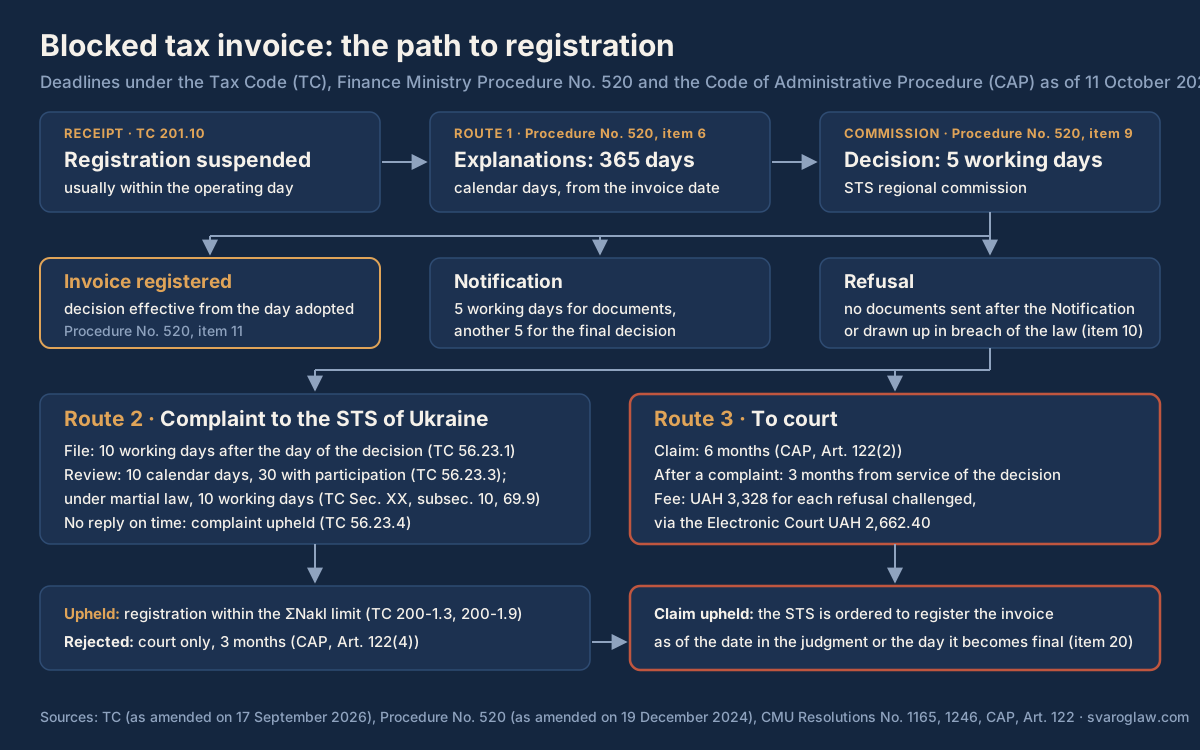
Unblocking a tax invoice starts with explanations: you submit them to the State Tax Service (STS) together with copies of documents within 365 calendar days from the date the invoice was drawn up (item 6 of Procedure No. 520). Within 5 working days, the regional commission registers the invoice, requests additional documents or refuses registration (item 9). A refusal is challenged either by a complaint to the State Tax Service of Ukraine within 10 working days or by a claim in an administrative court within 6 months (subparagraph 56.23.1 of the Tax Code, or TC; Code of Administrative Procedure, Art. 122(2)). If the complaint is rejected, you have 3 months from the day the decision on it is served to file a claim (Code of Administrative Procedure, Art. 122(4)).
Invoices are now suspended noticeably less often. According to the STS, 0.16% of tax invoices were suspended as of the beginning of August 2026, compared with 0.76% at the beginning of 2025. In 72% of cases the reason was an “imbalance in the virtual warehouse”, and in 20.7% the taxpayer’s risky status. We have not found nationwide statistics on unblocking tax invoices, but regional figures exist: in Sumy Region in April 2026, after reviewing explanations, the commission registered 306 of the 313 tax invoices and adjustment calculations it considered, i.e. 97.8%.
The criteria of Procedure No. 1165 and what the suspension receipt must contain
The Tax Code left it to the Cabinet of Ministers to set the grounds for suspension (TC 201.16), and they are established by Procedure No. 1165. An invoice that does not meet any of the conditions for unconditional registration is checked by automated monitoring against three lists: taxpayer risk criteria (Annex 1), positive tax history indicators (Annex 2) and transaction risk criteria (Annex 3). Meeting a single taxpayer risk criterion is enough for registration to be suspended (item 6). If it is the transaction that is found risky, the invoice is suspended unless the taxpayer has at least one positive history indicator (item 7).
Invoices registered without any check against the criteria include those of a taxpayer whose supplies are below UAH 1 million a month and up to UAH 100,000 per buyer, provided its director heads no more than 5 taxpayers and the VAT it has paid and declared exceeds UAH 40,000 (subitem 2 of item 3 of Procedure No. 1165). The positive tax history thresholds are higher: UAH 3 million and UAH 500,000 (item 1 of Annex 2). They were raised by Cabinet of Ministers Resolution No. 1048, in force since 27 September 2025.
The suspension receipt is sent to the seller and the buyer at the same time within the operating day (TC 201.10), and while martial law is in effect, for an invoice submitted on the last day of the registration deadline, no later than the next operating day (TC, Section XX, subsection 10, subparagraph 69.18). The receipt must state the criterion on which registration was suspended, its calculated value and an invitation to submit explanations and copies of documents (item 11 of Procedure No. 1165). Keep it: if the criterion is named only in general terms and the receipt does not say what exactly to submit, this may become an argument against a refusal.
Three ways to unblock a tax invoice
Unblocking a tax invoice begins with explanations, because a complaint or a claim is filed against the commission’s decision to refuse registration (item 12 of Procedure No. 520), and the commission adopts that decision after reviewing the explanations. The sequence works like this: after a complaint you can still go to court, but a decision already challenged in court can no longer be appealed administratively (TC 56.18, para. 2; item 4 of the Complaint Review Procedure).
Explanations and documents for the STS commission
365 daysWhen to choose it: as soon as you receive the receipt. Explanations are submitted to the STS electronically and are reviewed by a regional-level commission at the STS territorial body (items 2 and 7 of Procedure No. 520).
Deadline: 365 calendar days following the date the tax invoice or adjustment calculation was drawn up (item 6 of Procedure No. 520 as amended by Ministry of Finance Order No. 527, in force since 19 December 2024; previously the period ran from the date of the tax liability).
What you get: within 5 working days the commission registers the invoice, sends a Notification requesting additional explanations and documents, or refuses if the documents were drawn up or executed in breach of the law (item 9). You have 5 working days to respond, counting from the day after you receive the Notification, and within another 5 working days the commission adopts a final decision. If you do not respond, you will receive a refusal within 5 working days after the deadline.
Under the deadlines in the Procedure, up to 15 working days pass from submitting explanations to the final decision: 5 for the review, up to 5 for your additional documents and another 5 for the decision on them.
A complaint to the STS against the commission’s decision
10 working daysWhen to choose it: your documents are complete, but the refusal rests on a formal ground or ignores what you submitted. The complaint opens the administrative appeal against a refusal to register a tax invoice, and it is considered by the central-level commission of the State Tax Service of Ukraine.
Deadline: 10 working days following the day the decision was adopted (TC 56.23.1), so you count from the date of the decision, not from the day you opened it. A complaint filed later is not accepted, and a receipt saying so is sent automatically (item 8 of the Complaint Review Procedure); the Procedure does not provide for renewing a missed deadline.
What you get: a decision on the complaint. Subparagraph 56.23.3 of the Tax Code allows 10 calendar days for the review, or 30 if you have asked to take part, and this period cannot be extended. Participation is by videoconference, and you are given up to 15 minutes for oral explanations (item 11-2 of the Complaint Review Procedure). If a reasoned decision is not sent on time, the complaint is deemed fully upheld (TC 56.23.4). But even an upheld complaint leads to registration only if the ΣNakl registration limit in the VAT electronic administration system (SEA VAT), calculated under TC 200-1.3 or 200-1.9, is sufficient (item 18 of the Complaint Review Procedure). A decision rejecting the complaint can be challenged only in court (item 17).
While martial law continues, the transitional provisions of the Tax Code set a separate period: a complaint is considered within 10 working days of receipt (Section XX, subsection 10, subparagraph 69.9, para. 7). The STS Main Department in Zakarpattia Region, in a consultation of 25 July 2025, refers to 10 and 30 calendar days. We advise treating a complaint as upheld because of the STS’s silence only after the longer of these periods has expired.
Going to court: straight away or after a complaint
6 monthsWhen to choose it: the deadline for a complaint has passed, the State Tax Service of Ukraine has rejected the complaint, or the refusal is so lacking in reasons that the administrative stage would only waste time. The case in a district administrative court is handled by an administrative law lawyer, and in such a dispute it is the tax authority that must prove the refusal was lawful (Code of Administrative Procedure, Art. 77(2)).
Deadline: 6 months from the day you learned or should have learned of the refusal (Code of Administrative Procedure, Art. 122(2); Supreme Court, No. 1.380.2019.006517). After a complaint the period is different: 3 months from the day the decision on it is served, or, if it was not adopted or served on time, 6 months from the day the complaint was filed (Code of Administrative Procedure, Art. 122(4)). The Grand Chamber of the Supreme Court has expressly placed the blocking of tax invoices among the decisions for which the three-month period applies after an administrative appeal (No. 500/2276/24, 16 July 2025). The 1,095-day period under TC 56.18 does not apply here (No. 640/20468/18).
What you get: if the court finds the refusal unlawful, the refusal is set aside and the State Tax Service of Ukraine is ordered to register the invoice. The Supreme Court does not regard this as interference with the tax authority’s discretion: if the refusal has been set aside and the courts have found no grounds for refusing again, the tax authority has no lawful decision other than registration (No. 420/20638/24, 4 June 2026; No. 160/34198/23, 12 February 2025). The date of entry in the Register is the day stated in the court decision or the day it becomes final (items 19–20 of Procedure No. 1246), so ask for the invoice to be registered as of the date it was actually submitted.
The court fee is paid for each refusal decision challenged: UAH 3,328, or UAH 2,662.40 via the Electronic Court. The calculation is below the table.
Deadlines, outcomes and the court fee: every route in one table
| Route | Filing deadline | Review period | Outcome | Provision |
|---|---|---|---|---|
| Explanations and copies of documents | 365 calendar days from the date the tax invoice or adjustment calculation was drawn up | 5 working days | Registration, a Notification or a refusal | items 6 and 9 of Procedure No. 520 |
| Response to a Notification | 5 working days from the day after receipt | 5 working days | Registration or refusal | items 9 and 10 of Procedure No. 520 |
| Complaint to the State Tax Service of Ukraine | 10 working days after the day of the decision, cannot be renewed | 10 calendar days, 30 with participation; under martial law, 10 working days | Registration within the ΣNakl limit or refusal; decision not sent on time: complaint upheld | TC 56.23.1, 56.23.3, 56.23.4; TC, Section XX, subsection 10, subparagraph 69.9, para. 7 |
| Claim without a complaint | 6 months | Under the Code of Administrative Procedure | Refusal set aside and an order to register the tax invoice, or the claim dismissed | Code of Administrative Procedure, Arts 122(2), 245(1) and 245(4) |
| Claim after a complaint | 3 months from the day the decision on the complaint is served; 6 months from the day the complaint was filed if the decision was not served on time | Under the Code of Administrative Procedure | The same | Code of Administrative Procedure, Art. 122(4) |
A legal entity or sole proprietor (FOP) pays one subsistence minimum for able-bodied persons for such a lawsuit: UAH 3,328 in 2026, or UAH 2,662.40 via the Electronic Court with a coefficient of 0.8 (Law “On Court Fee”, Art. 4; Law on the State Budget for 2026, Art. 7). Setting aside a refusal and ordering registration of the invoice is a single claim (Supreme Court, No. 400/6051/21). But each refusal decision challenged is a separate claim with its own fee, even if they are all in one lawsuit (Law “On Court Fee”, Art. 6(3)). In case No. 160/7601/18 the Supreme Court agreed that 40 challenged decisions mean 40 claims and a fee for each. A hypothetical example: five refusal decisions and a lawsuit filed via the Electronic Court come to 5 × 2,662.40 = UAH 13,312 in fees; on paper it would be 5 × 3,328 = UAH 16,640. The fee for an appeal is 150% of the fee for the lawsuit, and for a cassation appeal 200%, but no more than 15 and 20 subsistence minimums respectively (in 2026, UAH 49,920 and UAH 66,560, or UAH 39,936 and UAH 53,248 via the Electronic Court).
What to attach to your explanations: the list in item 5 of Procedure No. 520
The Procedure names the following documents:
- Contracts, including foreign trade contracts, with their annexes
- Contracts, powers of attorney and acts of the governing body that formalise the authority of persons receiving goods on the taxpayer’s behalf
- Primary documents on supply or purchase, storage, transportation, loading and unloading: warehouse documents, inventory records, commercial invoices, acceptance certificates, delivery notes
- Payment documents and/or bank statements from personal accounts
- Declarations of conformity, quality certificates and certificates of conformity, if required by the contract or by law
- Other documents confirming the information stated in the tax invoice or adjustment calculation
One package can be submitted for several invoices if they were issued to the same buyer under the same contract or cover similar transactions with identical UKT ZED or DKPP codes (item 6). If the receipt names the code of the goods or service that caused the suspension, explanations are submitted only for that transaction (item 5). The Supreme Court reads “other documents” narrowly: these are documents that directly confirm the invoice data, i.e. its content, volume and product range. Documents on labour resources or staffing do not directly confirm the invoice, so the Supreme Court did not find a refusal lawful when it was based solely on their not being submitted (No. 400/996/25, 2 December 2025). But if the commission requested them in a Notification, you cannot stay silent.
Do not leave the commission’s Notification unanswered. Where the commission sent a Notification with a specific list and the taxpayer submitted nothing within 5 working days, the Supreme Court found the refusal lawful, even though the “Additional information” field in the decision had not been filled in (No. 140/12934/24, 2 July 2026). Objections that the requested documents are unrelated to the transaction must be raised with the commission, not the court. So respond to every Notification within those 5 working days, also electronically, even if only with an explanation of why a document does not exist or why it is not needed.
The Supreme Court on refusals that give no specifics
Case No. 420/42267/25: a refusal over defects in documents the commission did not name
As the ground for refusing registration, the commission cited “submission of copies of documents drawn up in breach of the law”. In the “Additional information” field it listed categories of documents and defects (consignment notes without the required details, missing certificates, etc.), but did not specify which documents or what the breach was. On 18 March 2026 the Odesa District Administrative Court found the refusals unlawful, on 19 May 2026 the Fifth Administrative Court of Appeal overturned that decision, and on 10 September 2026 the Supreme Court upheld the first-instance decision: the defendant “did not specify what exactly the defects in the primary documents consisted of”.
Separately, the Supreme Court explained the limits of review: the court assesses the commission’s decision on the reasons stated in it, because the procedure is designed so that “the taxpayer rebuts only those doubts that the supervisory authority has formulated and brought to its attention”. The court of appeal erred when it began assessing the lease of a machine tool and labour resources, which the commission had not mentioned in its decision.
How to apply this: rebut only the grounds named in the refusal, and if they are worded in general terms, point that out. The Supreme Court did not set out any separate conclusions in this case on which documents taxpayers under the simplified tax system (such as the claimant) must submit, so this ruling does not guarantee a win.
The Supreme Court has assessed receipts in the same way: where they contained only a general invitation to “provide explanations and copies of documents”, without a list of what to submit, and the taxpayer did submit documents, the refusal was found to be unreasoned (No. 160/29956/24, 29 January 2026, a case included in the case law review of the Administrative Cassation Court (ACC SC) for the first half of 2026; No. 340/4753/25, 24 September 2026). And invoice monitoring is no substitute for a tax audit: at this stage the legislature “did not provide for the powers of the supervisory authority to establish or assess the reality of business transactions” (No. 400/996/25).
If invoices are blocked again: risky status and the “virtual warehouse”
An unblocked invoice does not protect the ones that follow. If the taxpayer has been put on the list of risky taxpayers, new invoices will be suspended too, so a separate step is needed: submitting information and documents to the regional-level commission. It reviews them within 7 working days, and if no decision is adopted within that period, the taxpayer is removed from the list. A decision classifying the taxpayer as risky can also be challenged administratively or in court (item 6 of Procedure No. 1165). According to the STS, taxpayers most often end up on the list under item 8 of the criteria, on the basis of “tax information”, but a transaction from an invoice registered more than 180 days before the decision cannot serve as such a ground. A tax information code alone is not enough to put a taxpayer on the list, and the proper remedy is not only to set aside the decision but also to order the tax authority to remove the taxpayer from the list (Supreme Court, No. 160/7949/25, 25 June 2026). As of August 2026 the list contains 13.2 thousand taxpayers, compared with 24.9 thousand at the beginning of 2025.
The “virtual warehouse” (item 1 of the transaction risk criteria) is triggered when supplies under a UKT ZED or DKPP code exceed the purchases or imports under that code since 1 January 2017, multiplied by 1.5, less supplies already made. The criterion applies only if the code is not in the taxpayer’s accepted data table. The regional-level commission reviews a table with the codes of the goods and services you supply within 5 working days (item 15 of Procedure No. 1165). The table is accepted automatically only when several conditions are met at once, including at least 5 employees in each of the last 12 months (the conditions are different for agricultural producers, item 18).
Start with the criterion number in the receipt. If it is the “virtual warehouse” and you genuinely supply goods with that code, separately submit a taxpayer data table with that code and the codes of what you purchase for it (items 12–14 of Procedure No. 1165). Once the table is accepted, invoices suspended under the “virtual warehouse” criterion are registered automatically, subject to the conditions of item 16-1. But if your invoices are blocked every month, one complaint is not enough: you need to decide what to challenge first, the refusal to register or the decision classifying you as risky. For help with this choice, turn to a lawyer who handles tax disputes with the STS and bring all the receipts, commission decisions and the data table.
While the invoice is suspended: fines, the buyer and a missed complaint deadline
Will you be fined for non-registration while the invoice is blocked?
No. While registration is suspended, that is, until a decision on resuming it, fines for missing the registration deadline are not imposed (TC 120-1.1, 120-1.2). In case No. 560/12765/24 (3 December 2025) the Supreme Court added that even after 365 days from the suspension the invoices remain “suspended” rather than “unregistered”, and agreed with the cancellation of a tax assessment notice imposing a fine of UAH 69,892.08. We have not found an answer in Supreme Court case law on whether registration can be obtained through the courts after the 365 days have expired. If the STS has nevertheless imposed a fine, your remaining option is challenging the tax assessment notice imposing the fine for non-registration. The deadline for that runs from the day of service, so first establish the date a tax assessment notice was served in the Electronic Cabinet.
What can the buyer do if the seller does not submit explanations?
You cannot force the seller to register the tax invoice through the courts: the Grand Chamber of the Supreme Court has held that such a claim is not a remedy and is not heard by a court of any jurisdiction (No. 908/1568/18, 5 June 2019). What you can demand from the counterparty is compensation for damages. Meanwhile, the buyer’s deadline does not run out: the 365 days to include VAT in the tax credit are interrupted for the entire suspension period (TC 198.6).
What if you missed the 10 working days for a complaint?
Court is the only option left. A late complaint will not be accepted, and the Procedure does not provide for a request to renew the deadline, as the STS itself points out. A claim without a complaint is filed within 6 months (Code of Administrative Procedure, Art. 122(2)), and a late claim may be left without consideration: this happened in case No. 1.380.2019.006517 concerning the registration of an invoice, and on 20 November 2020 the Supreme Court agreed.
What to read in the original: the Tax Code, Procedures No. 1165 and No. 520, Supreme Court rulings, STS data
- Tax Code (as amended on 17 September 2026): paragraph 56.18, subparagraphs 56.23.1–56.23.4, paragraphs 120-1.1, 120-1.2, 198.6, 200-1.3, 200-1.9, 201.10, 201.16, subparagraphs 69.9 and 69.18 of subsection 10 of Section XX — zakon.rada.gov.ua; Code of Administrative Procedure, Arts 77, 122, 245 — zakon.rada.gov.ua; Law “On Court Fee”, Arts 4, 6 — zakon.rada.gov.ua; Law “On the State Budget of Ukraine for 2026”, Art. 7 — zakon.rada.gov.ua
- Cabinet of Ministers Resolution No. 1165 (Procedure for Suspending Registration, risk criteria, Complaint Review Procedure; as amended on 27 September 2025) — zakon.rada.gov.ua; Cabinet of Ministers Resolution No. 1048 — zakon.rada.gov.ua; Procedure approved by Ministry of Finance Order No. 520 (as amended on 19 December 2024) — zakon.rada.gov.ua; Procedure for Maintaining the Unified Register of Tax Invoices, approved by Cabinet of Ministers Resolution No. 1246, items 19–20 — zakon.rada.gov.ua
- STS: suspension statistics (7 August 2026), share of suspensions and their reasons (17 February 2026), changes under Resolution No. 1048 (25 September 2025); STS Main Department in Sumy Region (7 May 2026); STS Main Department in Zakarpattia Region (25 July 2025)
- Supreme Court rulings: No. 420/42267/25 (10 September 2026), No. 340/4753/25 (24 September 2026), No. 140/12934/24 (2 July 2026), No. 160/7949/25 (25 June 2026), No. 420/20638/24 (4 June 2026), No. 160/29956/24 (29 January 2026), No. 560/12765/24 (3 December 2025), No. 400/996/25 (2 December 2025), No. 160/34198/23 (12 February 2025), No. 400/6051/21 (8 February 2022), No. 1.380.2019.006517 (20 November 2020), No. 640/20468/18 (11 October 2019), No. 160/7601/18 (28 March 2019); Grand Chamber No. 500/2276/24 (16 July 2025), No. 908/1568/18 (5 June 2019)