
Олександр Сич
24 November 2026
Yes, you can privatise a dacha plot even now if it was given to you for use no later than 31 December 2001 and you can prove this with documents. The ban on the free transfer of state and municipal land during martial law (sub-paragraph 5 of paragraph 27 of Chapter X of the Land Code) does not extend to the transfer to citizens of “land plots transferred for use before this Code came into force”, and the Code came into force on 1 January 2002. If none of the exceptions in that sub-paragraph applies, even the preparation of land management documentation is prohibited under martial law.
As of 15 November 2026, the exception is in force. The ban has applied since 7 April 2022, and the exception appeared on 19 November 2022 (Law No. 2698-IX). Law No. 4625-IX, in force since 19 December 2025, did not change it and only added one more exception: for owners of property destroyed by the war. Martial law was last extended by Decree No. 1060/2026 from 31 October 2026 for 90 days, which by our count means until the morning of 29 January 2027.
We have not found a Supreme Court ruling that applied this exception to a specific plot: the Administrative Cassation Court (ACC SC) only quotes it, and it has been applied by appellate and first-instance courts. So the privatisation of a dacha plot under this exception rests on evidence: to whom, when and on what basis the land was transferred.
How to privatise a dacha plot given before 2002: four situations
This is the strongest position: the Seventh Administrative Court of Appeal applied the exception to a plot granted by a village council decision of 14 March 2001, backed up by entries in the household register books and a certificate from the council. The court of appeal upheld the judgment that had set aside the refusal and ordered the council to adopt a decision granting permission (case No. 600/1877/24-а, 16 September 2025). The plot there was for personal peasant farming (0.46 ha), and the register contains no cassation decisions in that case.
The association received the land before 2002, but you became a member later: the law gives no direct answer here, because the words “transferred for use” do not say to whom. We found neither Supreme Court rulings nor a direct finding by a court of appeal. The closest case we found does not answer the question: the Kyiv District Administrative Court (case No. 320/28253/24) did not analyse the exception, and the claimant, although admitted to the association only in 2008, had used the plot since 1985 and owned a garden house on it. If the land is still in the association’s use, it can be transferred to you only after that right has been terminated (Art. 116(5) of the Land Code), so look for a decision of the general meeting or the association’s waiver of that part. We do not promise an outcome: first show your documents to a land lawyer.
Without proof of a transfer before 2002, the Rivne District Administrative Court dismissed the claim (case No. 460/21063/25). Even an executive committee decision of 16 February 1995 with archival confirmation was held insufficient by the Cherkasy District Administrative Court, because it “does not contain the essential characteristics of the land plot” (case No. 580/13576/25). Look for a document that shows the location, boundaries and designated purpose.
This exception does not apply: in case No. 140/5502/24 (gardening, 0.06 ha) a village council decision of 2008 did not help. If there is no other exception, the council’s refusal will be lawful, and the ban also covers the final stage, so the land will not be transferred even on the basis of a finished project (Supreme Court, case No. 160/10127/23). If the garden house is registered in your name, a separate exception for building owners may apply (the ACC SC interprets it narrowly: only a transfer for servicing that property within the limits of Art. 121, case No. 160/34929/24, para. 46), which we covered in our article on privatising the land under your own house. A lawyer for privatising land under a private house can help with such a case.
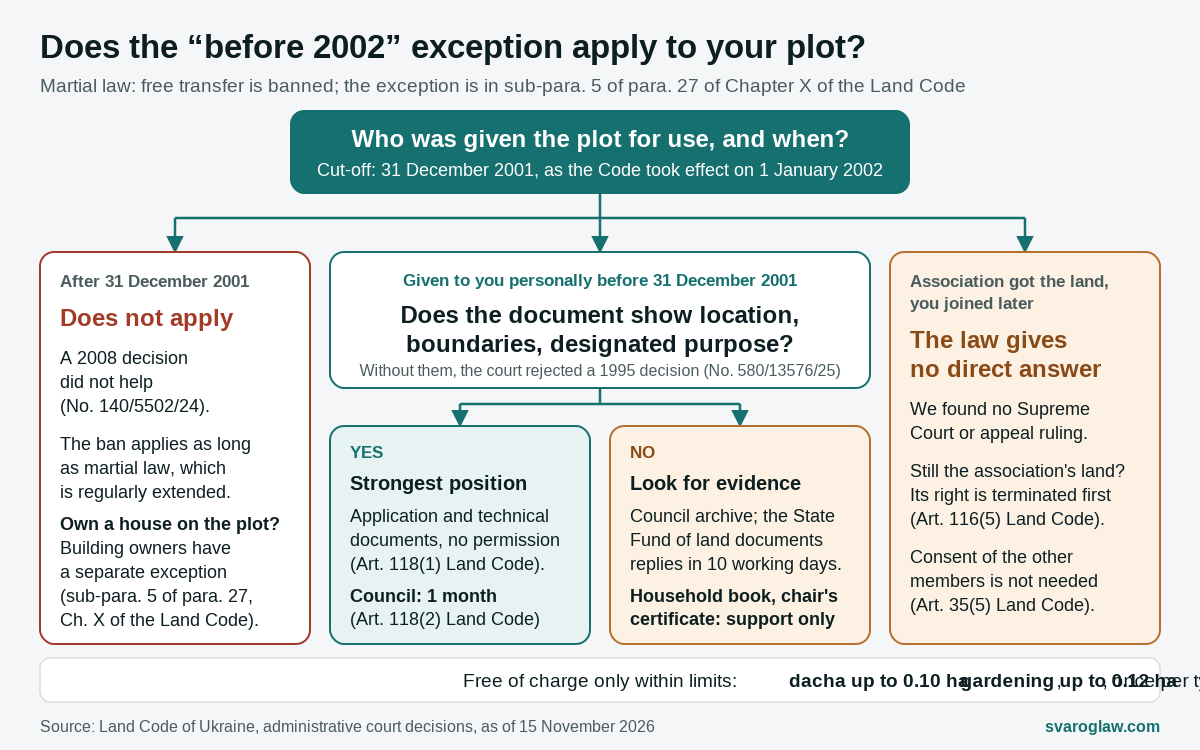
The Code treats dacha and garden plots differently. For individual dacha construction the limit is up to 0.10 ha (point “ґ” of Art. 121(1) of the Land Code), for gardening up to 0.12 ha (point “в”). Land is transferred free of charge within these limits and once for each type of designated purpose (Art. 116(4)); we have explained separately how many plots can be privatised free of charge. In everyday speech a garden plot is often called a dacha, so check the designated purpose in the decision granting the plot. A hypothetical example: a 0.11 ha plot fits within the gardening limit but exceeds the dacha limit by 0.01 ha (100 m²).
How to prove use before 31 December 2001
We found no separate list of documents for this exception in the law, so the table is based on what the courts have accepted or rejected.
| Document | Where to get it | What it proves |
|---|---|---|
| Decision of the executive committee, village council or district council granting the plot before 31 December 2001 | The council’s archive; if its files have been handed over, the district, city or regional state archive | The date and basis of the transfer. Without the location, boundaries and designated purpose it may not be enough (case No. 580/13576/25) |
| State land act for permanent use, lease agreement | Your own papers; a copy of the act can be requested from the territorial office of the State Geocadastre | The right of use itself: the Eighth Administrative Court of Appeal took such evidence into account (case No. 140/5502/24) |
| Land management documentation | State Fund of Land Management Documentation, request with the document’s code | May show the location, boundaries and area missing from a brief decision |
| Entry in the household register book, council certificate | Village, settlement or city council | Only supports the decision: the books “do not certify or create rights in rem” (case No. 580/13576/25). The Instruction on household records does not mention gardening associations, so there may be no entry |
| Membership book, certificate from the association’s chair | The association | Use, but we found no Supreme Court conclusion on whether such documents are sufficient. Submit them together with the original allocation decision |
| Decision allocating land to the association, its state land act | The council’s archive, the association | When and under what right the association received the land, i.e. whether its right must be terminated first (Art. 116(5) of the Land Code) |
The easiest place to start is a request to the State Fund of Land Management Documentation: its documents are public information (Art. 33 of the Law “On Land Management”), and according to the Diia Guide as of 15 November 2026 the service is free of charge and takes 10 working days.
Once the evidence has been gathered, you submit an application to the council together with technical documentation on establishing the boundaries, and no permission is needed to prepare it (Art. 118(1), second paragraph, of the Land Code). The council has one month to approve it and transfer the plot or give a reasoned refusal (Art. 118(2)). The route via a land allocation project is longer: a month for permission and two weeks to approve the finished project (Art. 118(7) and (9)). If the council stays silent on that route, only the owner of real estate on the plot may order a project without permission (Art. 118(7), second paragraph). With a pre-2002 decision in hand, you can file the application yourself, without a lawyer. But if documents are missing or the council has already refused, it is easier to handle the privatisation of a land plot with a lawyer.
Refusal or silence from the council: 6 months to sue under Art. 122 CAP and what to ask the court for
- Read the reasons. Outside the exceptions, the ban is an “independent and sufficient legal ground” for a refusal (ACC SC, case No. 160/34929/24, 13 March 2026, para. 41). It protects a refusal only if the council actually relied on it: in that case the annex to the decision gave a different ground, and the court declined to substitute its own reasons for the council’s (paras. 53–55).
- Show the council your evidence. In case No. 260/6269/24 the Eighth Administrative Court of Appeal noted that the applicant should already have submitted proof of a transfer before 2002 to the council. The Seventh Administrative Court of Appeal applied the exception on the basis of evidence in the case file, even though only a passport, tax number and graphic materials had been attached to the application (case No. 600/1877/24-а), and it is the council that must prove in court that its decision was lawful (Art. 77(2) of the Code of Administrative Procedure, CAP). So submit the documents together with the application and name the exception explicitly.
- If the council has not replied, the court may order it to consider the application and adopt a reasoned decision: that was the outcome on a 2025 application concerning a plot for a residential house in a gardening association (Eighth Administrative Court of Appeal, case No. 500/4518/25, 25 August 2026). But if there are no grounds for the exception, the council can lawfully refuse because of the ban even after such a court ruling.
- You have six months to file a claim with the district administrative court from the day you learned or should have learned of the violation (Art. 122(2) CAP). In case No. 160/29494/25 the court rejected a claim about the council’s inaction from 16 February to 7 April 2022 as time-barred: the lawsuit was filed only in October 2025.
- Ask for what the court can give. If the exception is proven, ask the court to set aside the refusal and order the council to adopt a decision granting permission (case No. 600/1877/24-а). Without grounds for the exception, the council cannot be ordered to grant permission (ACC SC, case No. 320/8323/21, para. 52; case No. 380/11336/22, para. 59), so the realistic outcome is that the unlawful refusal is set aside and the application is reconsidered, at which point the council must take the ban into account (case No. 160/34929/24, para. 61) and may lawfully refuse again. Nor can the court transfer the plot itself: the Civil Cassation Court held that recognition of ownership of the association’s land was an improper remedy, even though the claimant had both membership and a garden house (case No. 175/1512/16-ц, 15 July 2019).
Other questions: the association’s consent, 2008, the registrar
Do you need the consent of the chair or other members of the association?
The consent of other members of the gardening association is not required: privatisation “is carried out without the consent of other members of that association” (Art. 35(5) of the Land Code), and the decision on the transfer is made by the council or the administration (Arts. 116, 118 and 122 of the Land Code). If the plot was originally granted to you personally, Art. 118(1) of the Land Code does not list the chair’s consent among the documents to be attached to the application either. It is a different matter if the plot is still part of the land granted to the association itself for use. In that case its right to that part is terminated first (Art. 116(5) of the Land Code), and on the route via an allocation project the land user’s consent is attached to the application (Art. 118(6) of the Land Code), so you will need a decision of the general meeting or the association’s waiver of that part. Art. 35(5) says nothing specifically about dacha cooperatives.
Is the right of use lost if it was not re-registered by 2008?
No. The Constitutional Court declared unconstitutional the obligation to re-register permanent use by 1 January 2008 and stressed that citizens “cannot lose the right to use a land plot previously granted to them” (decision No. 5-рп/2005). Those who under Art. 92 of the Land Code cannot hold such a right may buy the land without an auction (para. 6-1 of Chapter X). This is a separate, paid route, and those who have not bought the land keep their right of use. Cabinet of Ministers Decree No. 15-92, which provided for the transfer of garden and dacha plots into private ownership during 1993 within the limits, is no longer in force (Law No. 139-V of 14 September 2006).
Can you order a project for a dacha plot now in order to submit it after martial law?
If there is no exception, no: both permissions and the preparation of the documentation itself are prohibited (sub-para. 5 of para. 27 of Chapter X of the Land Code). In case No. 300/3771/22 the ACC SC noted that applicants “are not deprived of the opportunity” to obtain permission after martial law ends; the dispute there arose before the exception was introduced.
Can the registrar demand documents from the 1990s?
Once the council has already decided on privatisation, the Eighth Administrative Court of Appeal did not support such a demand: the registrar “is not vested with the power to exercise control” over the lawfulness of the council’s decisions (case No. 380/6942/26, 29 October 2026). The grounds for the exception there (a plot under a house, a 1994 executive committee decision) were checked by the settlement council, and the court did not decide whether they actually existed. The ruling can be appealed in cassation only on the grounds set out in Art. 328 CAP.
What this answer is based on: Land Code, CAP, Constitutional Court decision, Unified State Register of Court Decisions
- Land Code (as of 15 November 2026): Arts. 35, 116, 118, 121, para. 1 of Chapter IX, paras. 6, 6-1 and sub-para. 5 of para. 27 of Chapter X; CAP, Arts. 77, 122; Law “On Land Management”, Art. 33; Constitutional Court decision No. 5-рп/2005 of 22 September 2005; Presidential Decree No. 1060/2026 of 26 October 2026, approved by Law No. 5029-IX of 26 October 2026; Cabinet of Ministers Decree No. 15-92; Instruction on Keeping Household Records; the service in the Diia Guide
- Supreme Court rulings: case No. 160/34929/24 (13 March 2026), No. 160/10127/23 (23 September 2025), No. 320/8323/21 (29 January 2025), No. 640/14211/19 (14 November 2024), No. 380/11336/22 (18 September 2024), No. 300/3771/22 (3 August 2023), No. 175/1512/16-ц (15 July 2019)
- Courts of appeal: case No. 380/6942/26 (29 October 2026), No. 500/4518/25 (25 August 2026), No. 160/29494/25 (20 August 2026), No. 260/6269/24 (1 October 2025), No. 600/1877/24-а (16 September 2025), No. 140/5502/24 (20 January 2025)
- First instance: case No. 580/13576/25 (6 February 2026), No. 460/21063/25 (19 January 2026), No. 320/28253/24 (10 March 2025)