

Олександр Сич
28 October 2026
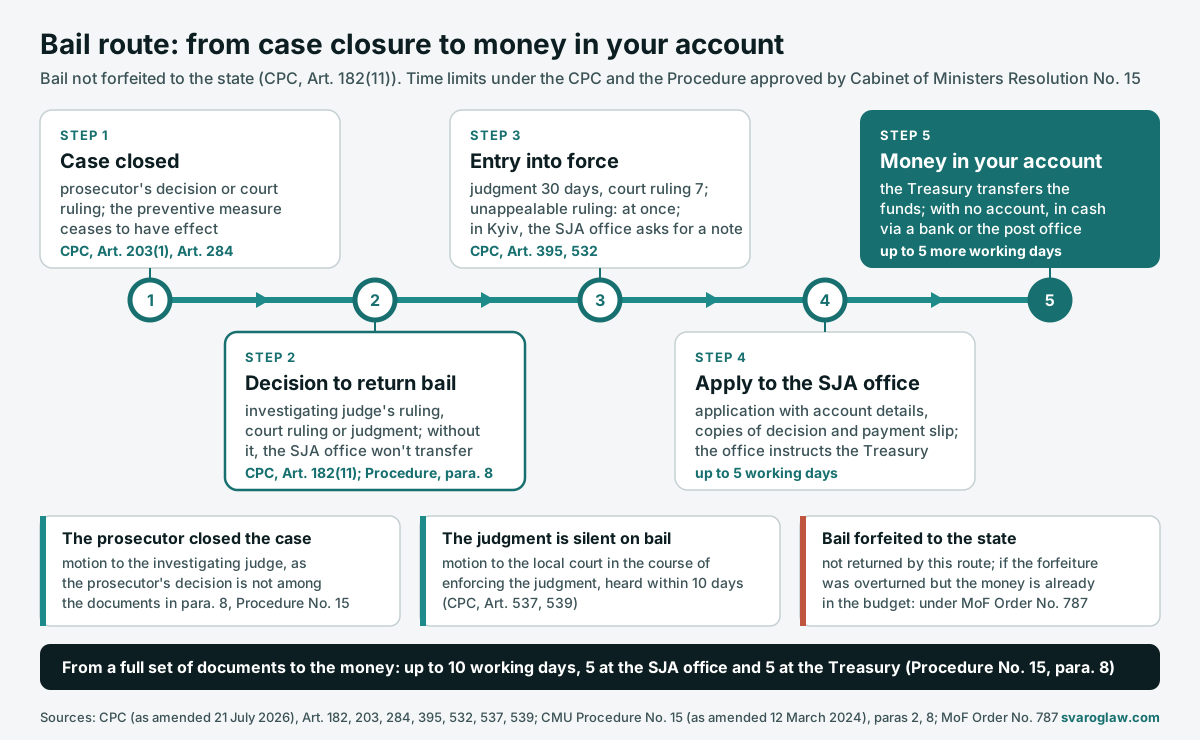
Bail that has not been forfeited to the state is returned to the suspect, the accused or the bail provider once the preventive measure has ended (CPC, Art. 182(11)). The territorial office of the State Judicial Administration (SJA), or the court of appeal, the High Anti-Corruption Court (HACC) or the Supreme Court if it was one of them that set the bail, will transfer the money only on the basis of an investigating judge’s ruling, a court ruling or a judgment containing a decision to return the bail. A prosecutor’s decision to close the case is not among the documents required for this (paragraph 8 of the Procedure approved by Cabinet of Ministers Resolution No. 15).
If you paid bail for your son, brother or husband, you may be the last to learn that the case has been closed: a copy of the prosecutor’s decision is sent to the suspect, defence counsel and the victim, and the bail provider is not on that list (CPC, Art. 284(6), paragraph 2). A claim against the territorial office of the SJA in an administrative court will not help either: the wife of an accused filed such a claim over UAH 42,630 of bail, and the Grand Chamber of the Supreme Court agreed that bail issues are resolved in criminal proceedings (No. 807/295/18).
Motions for bail as a stand-alone preventive measure are few: in 2025 investigating judges of local general courts considered 1,104 such motions, compared with 36,008 motions for detention in custody (SJA, Form No. 1-к). But bail also appears in detention rulings: when ordering detention, the investigating judge or the court must set the amount of bail, except in the cases listed in Article 183(4) of the CPC. Once the money is paid, the person is released and is considered to be subject to bail (CPC, Art. 202(4)). So this kind of bail is also returned under the rules described below. How bail is chosen and within what limits we covered in our article on preventive measures and the amount of bail in 2026; here we deal only with getting the money back after the case is closed.
When the right to have bail returned arises
A ruling on a preventive measure ceases to have effect when its term expires, an acquittal is delivered, the proceedings are closed or the preventive measure is revoked (CPC, Art. 203(1)). Article 132(4) repeats this rule for all measures to secure criminal proceedings, so a prosecutor’s decision to close the case also ends the bail. For bail, the term hardly matters: Vira Mykhailenko, a judge-spokesperson of the HACC, explained on the court’s website that “bail is an open-ended preventive measure”. Only the obligations imposed together with it last up to two months, with the possibility of extension (CPC, Art. 194(7)). In case No. 308/1220/22 the Supreme Court summed up that bail is returned to the bail provider only after the preventive measure has ended and on the basis of a judgment or ruling containing a decision to return it.
Next, find out who closed the case. If there is a suspect in the proceedings, the decision to close them is made by the prosecutor, not the investigator (CPC, Art. 284(4)), while a court closes proceedings by a ruling, including in connection with release from criminal liability (Art. 284(2)). A non-exonerating ground does not prevent the return: on 21 September 2026 the Cherkasy Court of Appeal closed proceedings because the limitation period had expired and, in the same ruling, ordered the bail to be returned (No. 693/824/16-к). A criminal defence lawyer can help you sort out the ground and the procedure for closure, because this determines which court you have to go to for a decision on the bail.
While the proceedings are ongoing, the bail remains in force, and without a motion for lifting or varying a preventive measure in court the money stays on deposit. During martial law, an investigating judge or a court may, on a motion by the suspect or the accused, replace bail with a personal undertaking so that these funds can be paid into special NBU accounts for defence purposes (CPC, Art. 616(5)). None of this applies to temporarily seized items and money: they are governed by Article 169 of the CPC, and the return of seized property has to be pursued separately.
Who is entitled to collect the bail
Bail may be paid by the suspect or the accused, or by another individual or legal entity, that is, a bail provider (CPC, Art. 182(2)). The bail provider is a separate participant in criminal proceedings (Art. 3(1)(25)), and courts consider bail providers’ own motions for return (No. 761/31755/26, No. 760/21792/26). Procedure No. 15 distinguishes between “the person” (the suspect, or whoever pays on their behalf) and the bail provider, who pays the funds in their own name (paragraph 3). The money is returned “to the person or the bail provider” (paragraph 8). Look at the payment instruction to see who is named as the payer and what is written in the payment reference. The regulations do not say directly to whom the bail is returned if a relative paid specifically on behalf of the suspect.
| Who paid the bail | Who is entitled to collect it | What is needed besides the decision to return it |
|---|---|---|
| The suspect or the accused personally | That person | Nothing extra, but under the judgment the court may apply their bail towards property penalties even without their consent (CPC, Art. 182(11)) |
| A relative or another individual in their own name | The bail provider or their representative | The representative’s authority must come from the bail provider: the court did not accept the documents of the suspect’s defence counsel (No. 643/5771/26) |
| Several bail providers | Each one their own share | A separate motion is possible: out of UAH 199,680 of bail, the Shevchenkivskyi District Court of Kyiv returned to one of the two bail providers the UAH 150,000 she had paid (No. 761/31755/26) |
| A private-law legal entity | That legal entity | An application in its name; state-owned, municipal and budget-funded entities, entities with a state or municipal stake and entities owned by a state or municipal business cannot be bail providers (CPC, Art. 182(2)) |
| A bail provider who has since died | Their heirs | A certificate of inheritance (No. 450/848/18) or a notary’s letter identifying the heir (No. 488/1700/15-к) |
Motion for the return of bail and application to the territorial office of the SJA: what to file and when
- Obtain the decision closing the case. A bail provider will have to ask the suspect or defence counsel for a copy of the prosecutor’s decision. If the court ruling or judgment already contains a decision to return the bail, go to step 4. While the case is in court, ask for the fate of the bail to be decided in the judgment: the court is in any case obliged to decide what to do with the measures to secure criminal proceedings (CPC, Art. 368(1)(14)). This is best taken care of during defence at the trial stage.
- The prosecutor closed the case: a motion to the investigating judge. Procedure No. 15 does not list the prosecutor’s decision among the documents, so an investigating judge’s ruling is needed. For example, after a prosecutor of the Specialised Anti-Corruption Prosecutor’s Office (SAPO) closed proceedings, an HACC investigating judge ordered UAH 398,000 to be returned to the bail provider (No. 991/9871/23). Attach the decision to close the case, the ruling imposing bail, the payment instruction and your bank account details: the Kyiv City Court of Appeal refused to return UAH 1,500,000, among other reasons because the application contained neither account details nor proof that the funds had been paid (No. 757/4852/17-к).
- The judgment is silent about bail: a motion in the course of enforcing the judgment. It is considered by the local court within 10 days (CPC, Art. 537(1)(14), Art. 539(3)), and it may be filed by the bail provider, the convicted person or defence counsel (Criminal Cassation Court of the Supreme Court (CrCC SC), No. 754/6807/21). If a court ruling closing the proceedings said nothing about bail, the Code does not set out a direct procedure: which court to apply to is best clarified with a lawyer.
- Wait until the decision enters into force and get a certified copy. If no appeal is filed, a judgment enters into force 30 days after it is pronounced, and a ruling of a court of first instance 7 days after it is announced (CPC, Art. 395(2), Art. 532(1)). If the decision was made without summoning the person, the period for that person runs from the day they receive a copy (Art. 395(3)). A ruling that cannot be appealed takes effect from the moment it is announced (CPC, Art. 532(5)), and according to the CrCC SC, an investigating judge’s ruling on the return of bail is such a ruling.
- Submit an application where the money was paid. This is the territorial office of the SJA that supports the court which set the bail, or the court of appeal, the HACC or the Supreme Court itself, if it set the bail (Procedure No. 15, paragraphs 2 and 8). Within 5 working days the office submits a payment instruction to the Treasury, and the Treasury transfers the funds to the account within the next 5 working days. If there is no account, the money is returned in cash through a bank or the post office.
Procedure No. 15 requires three documents, while the territorial office of the SJA in Kyiv asks for several more in its application form. Look for the application form and bank details on the website of the territorial office of the SJA for your region.
- An application for the return of bail with your bank account details (paragraph 8 of Procedure No. 15); in Kyiv, also a bank certificate with the account details.
- A court-certified copy of the ruling or judgment containing the decision to return the bail. In Kyiv, it must bear a note that it has entered into force, the signatures of a court officer and the judge, and the official court seal.
- A copy of the payment instruction used to pay the bail.
- Copies of the recipient’s passport and taxpayer ID (RNOKPP) certificate (a requirement of the territorial office of the SJA in Kyiv).
- A certificate of inheritance, if the bail is being received by an heir (in No. 488/1700/15-к, a notary’s letter was enough for the court). The certificate is issued once six months have passed since the inheritance was opened (Civil Code, Art. 1298(1)).
If the ruling or judgment already says that the bail is to be returned to you specifically, you can submit the application to the territorial office of the SJA without a lawyer.
When bail will not be returned, or not in full
- The bail has been forfeited to the state. The grounds are: a properly notified suspect or accused fails to appear when summoned without a valid reason or fails to report the reasons for not appearing; the suspect or accused breaches other obligations; or the bail provider fails to fulfil their own obligations (CPC, Art. 182(8)). The bail provider is also answerable for the suspect’s conduct (Art. 182(3)): the CrCC SC upheld the forfeiture of UAH 31,530 because, less than a month after the bail was paid, the accused committed a new crime (No. 554/675/20). In 2025 investigating judges of local general courts granted 62 of 104 such motions (SJA, Form No. 1-к).
- Courts have overturned forfeitures made without notifying the bail provider or without proof of a breach. The issue is decided at a hearing with the participation of the suspect or the accused and the bail provider, but the absence of someone who was properly notified of the time and place of the hearing does not prevent it from going ahead (Art. 182(9)). The CrCC SC removed the forfeiture of UAH 97,440 from a ruling of the court of appeal because the bail provider had not been notified of the hearing (No. 639/8559/15-к). The Zhytomyr Court of Appeal overturned an order forfeiting UAH 671,000 to the state and transferring it in support of the Armed Forces of Ukraine: the breach of obligations had not been proven (No. 295/9448/23).
- The obligations have expired, but the bail is still in force. The CrCC SC upheld the forfeiture to the state of UAH 49,620 paid by a bail provider who was an advocate: bail “has no maximum period of validity”, and the expiry of the two-month term of the obligations does not end it (No. 308/1220/22).
- The bail has been applied towards property penalties under the judgment. The court may apply the accused’s bail towards them in full or in part, but a bail provider’s bail only with their consent (CPC, Art. 182(11)). In 2025 the Kyiv Court of Appeal amended a judgment under which, on the bail provider’s application, part of his bail had been applied towards civil claims: the victims had already been compensated, and the bail provider is entitled to the return of the full bail, UAH 200,000 (No. 755/18154/20).
- The forfeiture has been overturned, but the money is already in the budget. The court first establishes whether the funds were actually transferred (decision of the Civil Cassation Court of the Supreme Court (CCC SC) of 20 December 2023 in case No. 757/31820/19). If they were, according to the CCC SC, the money is returned on the submission of the territorial office of the SJA under the procedure approved by Ministry of Finance Order No. 787, rather than through a damages claim. In the same case, a mother who had paid UAH 70,000 for her son and demanded it back together with 3 % per annum, inflation losses and compensation for non-pecuniary damage had her claim dismissed (CCC SC decision of 12 March 2025).
Inheritance, a relative as bail provider, closure by an investigator, appeals: other questions people ask
Who gets the bail if the bail provider has died?
Their heirs: the estate includes the rights that did not end with the death of the deceased (Civil Code, Art. 1218), and the right to the return of bail is not among the exceptions in Article 1219. In 2020 the Mykolaiv Court of Appeal upheld the return of bail to the daughter of a deceased bail provider, although the prosecutor argued that the daughter was not a bail provider (No. 488/1700/15-к). In 2026 the Cherkasy Court of Appeal ordered UAH 110,240 to be returned “to the bail provider’s heirs” but did not identify a specific heir or account (No. 693/824/16-к). Ask the territorial office of the SJA in advance which document it will accept. We have not found any Supreme Court decisions on this issue.
Can the suspect or the suspect’s advocate collect bail paid by a relative?
No, if the relative paid in their own name: the money is returned to them as the bail provider (CPC, Art. 182(11)). On 24 March 2026 the Saltivskyi District Court of Kharkiv returned the motion of an advocate who held documents only as defence counsel of the deceased suspect, while the UAH 66,560 had been paid by the suspect’s mother (No. 643/5771/26). On 4 August 2026, on defence counsel’s appeal, the CrCC SC declined to review a judgment approving an agreement as regards the return of UAH 266,240 of bail: it had been paid by the convicted person’s former common-law wife, and defence counsel does not represent the interests of the bail provider (No. 743/314/26).
What if the proceedings were closed by an investigator?
Check who signed the decision. An investigator or inquiry officer closes proceedings only where no one has been notified of suspicion; where there is a suspect, the prosecutor does so (CPC, Art. 284(4)). Bail, however, is imposed on a suspect or an accused, so an investigator’s decision in such a case is questionable. Show it to a lawyer before filing a motion for the return of bail: a ruling imposing bail ceases to have effect after the proceedings are closed “in the manner provided for by this Code” (CPC, Art. 132(4)).
Can an investigating judge’s ruling on the return of bail be appealed?
No. It is not on the list in Article 309 of the CPC, so, according to the settled position of the CrCC SC, it cannot be challenged on appeal, and the Code does not provide for a cassation appeal against rulings of an investigating judge (No. 344/3610/19, No. 761/3112/23, No. 953/502/22). On this basis, on 8 September 2026 the Kyiv Court of Appeal refused to open appeal proceedings on the prosecutor’s appeal against a ruling returning UAH 266,240 to a bail provider (No. 760/21792/26). Constitutional Court Decision No. 8-р(II)/2026 concerned Article 309 only as regards temporarily seized property. Nor can an appeal be brought against a ruling by which an investigating judge closed proceedings on a repeat application for the return of bail (CrCC SC, No. 686/21508/17). Investigating judges themselves write different things in their rulings: the HACC stated that its ruling could not be appealed (No. 991/9871/23), while the Shevchenkivskyi District Court of Kyiv indicated a 7-day period for an appeal (No. 761/31755/26). That is why we recommend preparing the motion as if there will be no second attempt: in the name of the person who paid the money, and with a full set of documents.
Where the rules, cases and figures come from
- Criminal Procedure Code of Ukraine, Art. 3, 132, 169, 182, 183, 194, 202, 203, 284, 309, 368, 395, 532, 537, 539, 616 (as amended on 21 July 2026) — zakon.rada.gov.ua; Civil Code of Ukraine, Art. 1218, 1219, 1298 — zakon.rada.gov.ua
- Procedure approved by Cabinet of Ministers Resolution No. 15 of 11 January 2012 (as amended on 12 March 2024), paragraphs 2, 3, 8 — zakon.rada.gov.ua; Ministry of Finance Order No. 787 of 3 September 2013 — zakon.rada.gov.ua
- Territorial office of the SJA in Kyiv: return of bail and application form; HACC: judge-spokesperson’s column of 13 November 2019
- Supreme Court: Grand Chamber No. 807/295/18; Criminal Cassation Court No. 308/1220/22, No. 754/6807/21, No. 639/8559/15-к, No. 554/675/20, No. 344/3610/19, No. 761/3112/23, No. 953/502/22, No. 686/21508/17, No. 743/314/26; Civil Cassation Court No. 757/31820/19-ц — decisions of 20 December 2023 and of 12 March 2025
- Other courts: HACC investigating judge No. 991/9871/23; Kyiv Court of Appeal No. 760/21792/26, No. 755/18154/20; Kyiv City Court of Appeal No. 757/4852/17-к; Cherkasy No. 693/824/16-к, Mykolaiv No. 488/1700/15-к and Zhytomyr No. 295/9448/23 courts of appeal; Shevchenkivskyi District Court of Kyiv No. 761/31755/26, Saltivskyi District Court of Kharkiv No. 643/5771/26, Pustomyty District Court No. 450/848/18
- SJA: Form No. 1-к for 2025, Section 3
The case has been closed, but the money is still on deposit?
Today, find the payment instruction for the bail and the ruling that imposed it. If you are the bail provider, ask the suspect or defence counsel for a copy of the decision to close the case. We will check whether the preventive measure has ended and whether the bail is at risk of being applied towards property penalties, prepare a motion in the name of the person to whom the bail must be returned, and handle the submission of the documents to the territorial office of the SJA. If the proceedings are still ongoing, we will start with a motion to vary or lift the preventive measure.