
Олександр Сич
18 November 2026
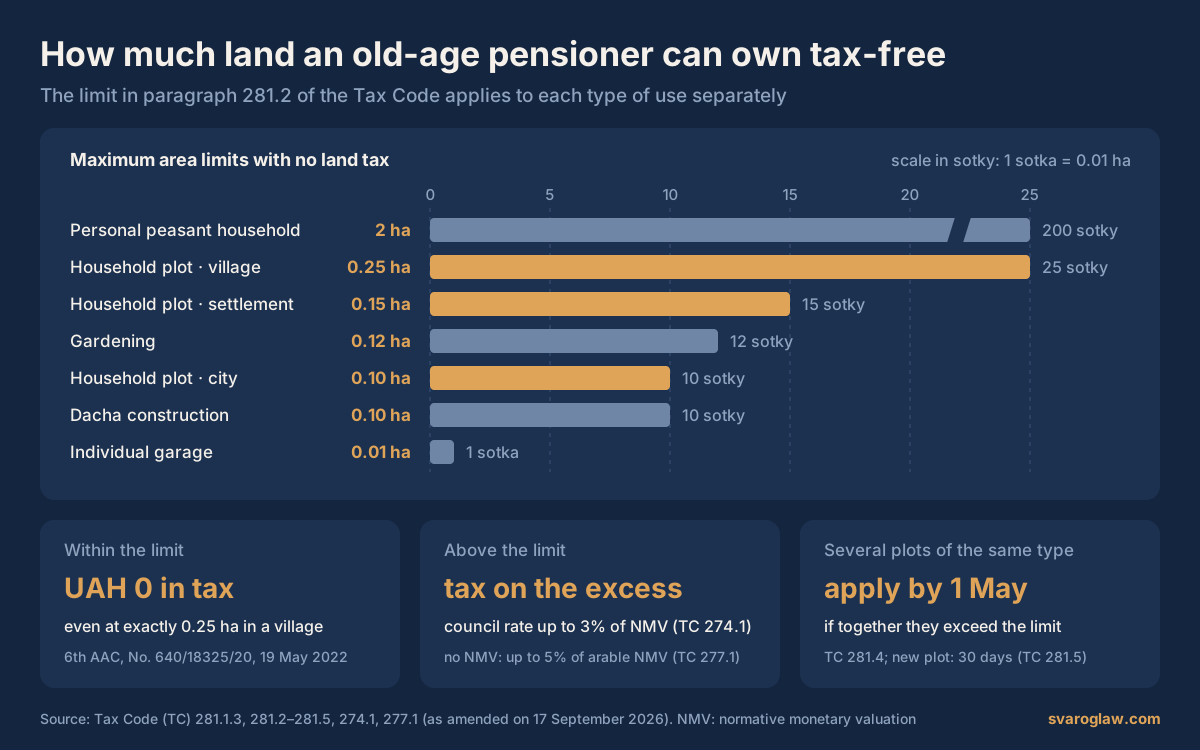
An old-age pensioner does not pay land tax on a household plot of up to 0.10 ha in a city, up to 0.15 ha in a settlement and up to 0.25 ha in a village (TC 281.1.3, 281.2.2). Also tax-free are a personal peasant household plot of up to 2 ha, a garden plot of up to 0.12 ha, a dacha plot of up to 0.10 ha and a garage plot of up to 0.01 ha, because the exemption applies to each type of use separately (TC 281.2). If a plot is larger than the limit, the exemption covers only the limit and the rest of the area is taxed. Land that a pensioner leases out is taxed under the general rules (TC 284.3), except when it is leased to a Group 4 single-tax payer: in that case the owner is exempt from tax for the whole period the tenant stays in that group (TC 281.3).
In its old wording, paragraph 281.2 extended the exemption to “one land plot for each type of use”. Law No. 2245-VIII of 7 December 2017 removed that “one”, and the exemption now covers “land plots for each type of use within the maximum limits”. The old formula still turns up even in court decisions: the Sixth Administrative Court of Appeal quoted it in September 2026 (No. 640/20534/20), although in that case it still upheld the judgment that had cancelled the pensioner’s tax assessment notice in full.
The area limits within which no land tax is charged to old-age pensioners are the same as for the other beneficiaries listed in TC 281.1: people with Group I and II disabilities, those raising three or more children under 18, war veterans and persons covered by the Law “On the Status of War Veterans and Guarantees of Their Social Protection”, and victims of the Chornobyl disaster. We checked the limits against the Tax Code as amended on 17 September 2026, in force as of 25 October 2026.
Land tax for pensioners: area limits by type of plot
The type of use is the plot’s designated purpose; the tax office takes it from the State Land Cadastre and the land documents (TC 286.1). The Tax Code treats a household plot as a plot for building and maintaining a residential house, outbuildings and structures. The limits under TC 281.2:
| Type of land use | Exempt from tax | Tax Code provision |
|---|---|---|
| Running a personal peasant household | up to 2 ha | TC 281.2.1 |
| Household plot in a village | up to 0.25 ha (25 sotky) | TC 281.2.2 |
| Household plot in a settlement | up to 0.15 ha (15 sotky) | TC 281.2.2 |
| Household plot in a city | up to 0.10 ha (10 sotky) | TC 281.2.2 |
| Individual dacha construction | up to 0.10 ha | TC 281.2.3 |
| Construction of an individual garage | up to 0.01 ha | TC 281.2.4 |
| Gardening | up to 0.12 ha | TC 281.2.5 |
Each limit is tied to its own type of use, so they cannot be added together: 5 unused sotky of the household-plot limit will not cover an excess on a garden plot. Nor does one limit interfere with another. Suppose a pensioner in a village owns a household plot of 0.25 ha, a personal peasant household plot of 1.8 ha and a garden plot of 0.12 ha, 2.17 ha in total. Each fits within its own limit, so there is no land tax on any of the three.
A plot larger than the limit: how tax on the excess is calculated
There is no tax even if the area is exactly at the limit. An old-age pensioner from the village of Khlepcha in Kyiv region owned a household plot of exactly 0.25 ha and a personal peasant household plot of 0.316 ha. On 19 May 2022, the Sixth Administrative Court of Appeal held that she was “exempt from paying such tax” and cancelled the tax assessment notice (No. 640/18325/20). There was no evidence of a reconciliation (zvirka) request in the case file, and the pensioner sent a copy of her pension certificate to the tax office only five days before filing the claim.
The exemption covers the area within the limit, and the rest is taxed at the local council’s rate. The tax base is the plot’s normative monetary valuation (NMV) adjusted by the indexation coefficient (TC 271.1.1), and the rate is no more than 3% of the NMV, or from 0.3 to 1% for agricultural land (TC 274.1). If no NMV has been carried out, the tax is calculated on the basis of area, and the rate may not exceed 5% of the NMV of a unit of arable land in the region (TC 271.1.2, 277.1).
We have not found a Supreme Court ruling directly on tax on excess area. This calculation follows from the wording of TC 281.2: the exemption applies only “within the maximum limits”.
A hypothetical calculation for a city plot. A household plot in a city measures 0.18 ha and the limit is 0.10 ha, so tax is charged on 0.08 ha, that is, 800 m². Suppose the NMV including indexation is UAH 1,000 per 1 m² (a hypothetical figure; take yours from the extract on the plot’s normative monetary valuation). The base for the excess is then UAH 800,000, and the annual tax depends on the council’s rate:
- 0.03%, as for individuals’ household plots in the Dnipro City Council decision cited by the court in case No. 160/34023/24: UAH 240;
- 1%, as set by Koblevo Village Council in Mykolaiv region for dacha plots in 2024–2025 (No. 400/10495/25): UAH 8,000;
- 3%, the maximum rate under TC 274.1: UAH 24,000.
Same area, yet the tax differs a hundredfold, so first find out your council’s rate for your particular designated purpose.
Land tax rates and exemptions for individuals are set by village, settlement and city councils (TC 284.1), so check whether your council has granted pensioners an exemption of its own. Decisions for the following year are adopted by 15 July, and if none is adopted, the rates in force until 31 December of the previous year apply (TC 12.3, 12.3.5). Rates for 2027 should have been published back in summer 2026, and they change noticeably: Koblevo Village Council set 1% for dacha plots in 2020, 2% in 2021–2023 and 1% again in 2024–2025.
The land tax exemption for pensioners: from which month it applies and when an application is needed
The exemption applies from the month after the one in which the right to it arose (TC 284.2). For example, if an old-age pension was granted in March, tax on a household plot within the limit will be charged only for January, February and March. The Tax Code does not require a separate application from the owner of one plot of each type, but the tax office may not know about the exemption, so check the calculation attached to your next tax assessment notice.
An application is needed in two cases. The first: as of 1 January you own several plots of the same type of use, say two household plots, and together they exceed the limit. Then, by 1 May, submit a written application in free form to the tax office where any of them is located and state which plots the exemption should apply to (TC 281.4). If you file on time, the exemption applies from that year; if after 1 May, from the next year. The second case has two variants: you are already a pensioner and during the year you bought or received a plot (even just one), or the right to the exemption arose mid-year when you already owned several plots of the same type. You then have 30 calendar days to apply, and if you miss that deadline, the exemption for the chosen plots will start applying from the next year (TC 281.5).
Without an application there may be no exemption at all. In November 2023 a pensioner in Dnipro received several plots ranging from 0.0552 to 1.5243 ha under gift agreements and did not file an application choosing among them. On 22 April 2026, the Third Administrative Court of Appeal agreed that she was not entitled to the exemption, because “the mere fact of belonging to a certain category exempt from paying land tax (old-age pensioners) is not a ground for applying the exemption” (No. 160/34023/24).
Long-service pension, lease, another type of plot: when there is no exemption
TC 281.1.3 refers to “pensioners (old-age)”, and in the Koblevo case the courts of both instances read that parenthetical literally (we have not found a Supreme Court ruling specifically on long-service pensions). The owner of a 0.10 ha dacha plot in the village of Koblevo in Mykolaiv region had received a long-service pension since 2017 and turned 60 on 7 August 2024. In tax assessment notices dated 7 August 2025, the tax office charged him land tax for 2020–2025, UAH 19,779.07 in total. On 17 September 2026, the Fifth Administrative Court of Appeal agreed with the Mykolaiv District Administrative Court that these notices were lawful: the Tax Code provides no exemption for long-service pensioners, and the claimant submitted no evidence that he had been granted an old-age pension (No. 400/10495/25). Nor did it help that he had applied for the exemption back in December 2017 with his long-service pension certificate. A pensioner with a Group I or II disability has a separate ground (TC 281.1.1) with the same area limits.
On 22 April 2024, the Main Department of the State Tax Service (STS) in Ternopil region explained that the exemption may also be available with a pension other than an old-age one, if the pensioner has reached retirement age and has the insurance record required by Article 26 of the Law “On Compulsory State Pension Insurance”. But this is the position of a single regional department, so we advise going through reconciliation with documents proving your age and insurance record and not counting on the exemption until the tax office applies it.
Lease, a garage on community land, non-residential premises. If a pensioner leases out a plot, a house or part of it, tax on that land is paid under the general rules (TC 284.3), except when it is leased to an agricultural producer in Group 4 of the single tax (see the question below). Anyone who rents land from the community pays not land tax but rent under the lease agreement (TC 288.1), and the exemptions of Article 281 do not apply to rent. On 15 April 2025, the Supreme Court ruled against a labour veteran who rented 0.005 ha from Kharkiv City Council for a garage: if the Tax Code has not established an exemption from rent, “such a person is not granted the relevant exemption” (No. 520/28375/23). In our view, the same conclusion applies to a pensioner who rents land. Finally, there is no exemption for types of use not listed in TC 281.2: the Supreme Court agreed that an old-age pensioner has no exemption for a plot used to maintain a property complex (No. 809/1472/16). The Supreme Court likewise refused the owner of non-residential premises in an apartment building an exemption for the land beneath them: the exemptions of Article 281 “do not extend to owners of non-residential real estate” (No. 816/1743/16).
If the designated purpose in your documents does not match how you actually use the land, you will first have to change the designated purpose or correct an error in the cadastre, and that is work for a land lawyer. The Article 281 exemption concerns land tax, which is paid by owners and permanent users of plots (TC 269.1.1). How to register ownership of the land under your house despite the martial-law moratorium is explained in our article on privatisation of the land under a house.
A tax assessment notice without the exemption: calculation, reconciliation, complaint, court
- Check the calculation attached to the notice. Individuals do not file land tax returns: by 1 July the tax office sends a tax assessment notice together with a detailed calculation that must show the plot’s cadastral number and area, the rate and the amount of the exemption (TC 286.2, 286.5, para. 1). The tax must be paid within 60 days of the notice being served (TC 287.5). For a plot you have sold, tax is charged only up to the start of the month in which your right ended (TC 286.5, para. 3), just as with property tax, where we explained how to cancel a tax assessment notice for a sold apartment.
- Request a reconciliation of data. Apply in writing or electronically to the tax office at your place of registration or where the plot is located and ask it to reconcile the areas, the rate and your right to the exemption, taking TC 281.4 and 281.5 into account (TC 286.5). Present the originals or attach duly certified copies of a document showing the type of pension (a pension certificate or a Pension Fund of Ukraine (PFU) statement) and the documents for the plot. If a discrepancy is confirmed, within 10 working days the tax office will recalculate the tax and send a new notice, and the previous one will be deemed withdrawn.
- 10 working days for a complaint. If reconciliation did not help, a complaint against the tax assessment notice is filed with the higher-level tax authority (against a decision of a Main Department of the STS, with the State Tax Service of Ukraine) within 10 working days following the day the notice was received (TC 56.3). The deadline runs from receipt of the notice, not from the reply on reconciliation, so file your reconciliation request in the first few days. After an administrative appeal, you have one month to go to court (TC 56.19).
- 6 months for a lawsuit. If there was no complaint to the STS, you have 6 months to challenge a land tax assessment notice in court (Code of Administrative Procedure, Art. 122(2)). According to the Grand Chamber of the Supreme Court, the 1095-day period concerns the limitation on assessing tax, not on going to court (No. 500/2276/24, 16 July 2025). In case No. 520/4343/25, a claim concerning a land tax assessment notice for 2023 was filed almost a year after the six-month deadline had expired, and in that part it was left without consideration; on 10 December 2025, the Supreme Court agreed, holding that martial law is not in itself a valid reason for missing the deadline.
Pensioners can file the reconciliation request and the plot-selection application themselves; no lawyer is needed for that. But if the tax office still refuses to recognise the exemption after reconciliation, or has sent notices for several years at once, a tax dispute lawyer will check whether the limitation period has expired for any of the years and assess which is more realistic: a complaint or going straight to court.
Where the rules and figures in this article come from
- Tax Code of Ukraine (as amended on 17 September 2026): paragraphs 12.3, 12.3.5, 56.3, 56.19, 102.1, Articles 269–271, 274, 277, 281, 284, 286–288, subparagraph 4 of paragraph 297.1 — zakon.rada.gov.ua; Code of Administrative Procedure, Article 122 — zakon.rada.gov.ua
- Supreme Court: No. 520/4343/25 (10 December 2025), No. 520/28375/23 (15 April 2025), No. 809/1472/16 (29 June 2022), No. 816/1743/16 (17 September 2020); Grand Chamber of the Supreme Court, No. 500/2276/24 (16 July 2025)
- Administrative courts of appeal: Sixth, No. 640/20534/20 (11 September 2026) and No. 640/18325/20 (19 May 2022); Fifth, No. 400/10495/25 (17 September 2026); Third, No. 160/34023/24 (22 April 2026)
- STS clarifications: Main Department of the STS in Ternopil region on the exemption for pensioners (22 April 2024)
A leased land share, a pensioner who is a sole proprietor, and notices for several years
Does a pensioner pay tax on a land share leased to an agricultural company?
If the tenant pays the Group 4 single tax, the owner of the plot or land share is exempt from land tax for as long as the tenant stays in that group, regardless of age and area (TC 281.3). On this ground, on 17 April 2026, the Zhytomyr District Administrative Court cancelled a tax assessment notice for UAH 9,170.97 for 2020, and on 11 September 2026, the Sixth Administrative Court of Appeal upheld that judgment: the pensioner had leased her 5.4134 ha personal peasant household plot to a company in Group 4 of the single tax, and her second plot, 1.5 ha, fit within the 2 ha limit for an old-age pensioner (No. 640/20534/20). The court of appeal rejected the argument that the tax office had not known about the lease: the exemption “depends on objective compliance with the conditions it sets, not on the awareness of the supervisory authority”. If the tenant is not in Group 4, tax on the leased land is paid under the general rules (TC 284.3). The Main Department of the STS in Ternopil region takes the view that the exemption does not extend to plots formed from land shares (pais). This is the position of a single regional department, but it is consistent with the wording of TC 281.2: the type “for commercial agricultural production” is not among its limits. So check the designated purpose of your land share in the extract from the State Land Cadastre.
Does a pensioner who is a single-tax sole proprietor pay tax on the land under a shop?
No, if you are in Group 1–3 and use the plot for business activity: TC 297.1(4) exempts such sole proprietors from land tax, whatever your age and the size of the plot. The exemption does not apply if you lease, let or lend the plot itself or the real estate on it, or otherwise hand it over for use. Nor does it cancel rent: if the shop stands on land rented from the community, a sole proprietor pays rent under the agreement even on the single tax.
The tax office sent notices for several years at once: is that lawful?
It is lawful if the tax office stayed within the limitation period: tax can be assessed for past years within 1095 days (TC 287.10, 102.1). This period was suspended, and in the Koblevo case the court held that the 2025 notices for 2020–2025 were lawful: it took into account three suspension periods that together ran from 18 March 2020 to 1 August 2023 (No. 400/10495/25). Under TC 287.9, an individual is released from liability for late payment if the notice was not sent within the deadlines of Article 286.