
Олександр Сич
27 November 2026
Compensation for unused annual leave = earnings for the reference period ÷ calendar days in that period × unused days. On dismissal it is paid for all unused days of annual leave for all years of work: the law sets no limit on the number of years (Labour Code, or LC, Art. 83(1); Law on Leave, Art. 24(1)). Of the amount accrued, 23 % is withheld: 18 % personal income tax (PIT) and 5 % military levy.
The calculation is done in two blocks: days to which the right arose before 31 December 2023 are multiplied by the average daily amount based on earnings accrued in 2023, and later days by the average for the 12 months preceding the month of payment (Procedure No. 100, clause 2). While martial law continues, public holidays are not excluded from the denominator, so it is usually 365 or 366 days.
Say you have built up dozens of days over several years, and the figure on your payslip is lower than it would be if all the days were multiplied by your current daily rate. This may not be a mistake: the second paragraph of clause 2 of the Procedure for Calculating Average Wages (Cabinet of Ministers Resolution No. 100, as amended by Resolution No. 957 of 8 September 2023) gave days accrued earlier a separate base. If your pay has risen since then, those days are worth less. On 1 February 2024 the Ministry of Economy explained that on dismissal in 2024 the employer “must calculate two average wages”; the second paragraph of clause 2 has not been amended since. This is the ministry’s position: the Procedure does not spell out a division into blocks; it follows from the first and second paragraphs of clause 2, and we have found no case law on the point.
Calculating compensation for unused annual leave: five steps under Procedure No. 100
- Days in two blocks: the first holds the days to which you became entitled before 31 December 2023, the second all later days. Annual leave and additional leave for employees with children are counted. A public holiday that falls within your leave during martial law counts as an ordinary day of leave, because LC Art. 73 and Art. 5(2) of the Law on Leave are suspended (Art. 6(6) of Law No. 2136-IX on labour relations under martial law).
- The period for each block: for the first it is the year 2023 (Procedure No. 100, clause 2, paragraph 2), for the second the 12 calendar months preceding the month of payment (clause 2, paragraph 1). If compensation is paid in November 2026, the second period runs from November 2025 to October 2026. If you worked for less than that, the time actually worked is used (clause 2, paragraph 3; clause 7). Where there were no earnings at all in the reference period (for example, the whole of 2023 was childcare leave), the average is calculated from the salary or tariff rate under the employment contract in force on the day of calculation, and if that salary is below the minimum wage, from the minimum wage (clause 2, paragraph 8; clause 4).
- Total earnings: here, unlike the two-month calculation, earnings include pay for periods when average earnings were retained (previous leave, business trips, forced absence) and sick pay (clause 3). One-off payments such as financial assistance, severance pay or leave compensation are not counted, nor are daily allowances or payments for holidays and anniversaries (clause 4, subclauses “б”, “в” and “и”).
- Dividing by calendar days: clause 7 of the Procedure requires public holidays and non-working days to be excluded, but under martial law (extended until 29 January 2027 as of 9 November 2026) LC Art. 73 does not apply. According to the Ministry of Economy, such days “are not excluded”, so for both blocks the total is divided by all 365 or 366 days. The only time excluded from the period is time when you did not work and your earnings were not retained or were retained only partly (for example, downtime or unpaid leave), and time for which there are no records because of hostilities (clause 2).
- Multiplying and tax: each block’s daily amount is multiplied by its days, the results are added up, and 18 % PIT (Tax Code, para. 167.1) and 5 % military levy at the standard rate (Tax Code, Section XX, subsection 10, para. 16-1, subpara. 1.3, item 1) are withheld. The definition of wages in subpara. 14.1.48 of the Tax Code does not mention leave compensation separately, but covers it with the words “compensation payments” in connection with employment.
38 days in two blocks: UAH 23,500 accrued, UAH 18,095 paid out
The figures in this hypothetical example are invented; the rules are real. An employee leaves in November 2026 with 38 unused days: 20 in the first block and 18 in the second. Earnings included in the calculation were UAH 182,500 in 2023 and UAH 273,750 from November 2025 to October 2026. There is no time to exclude.
- First block: 182,500 ÷ 365 = UAH 500 a day; 500 × 20 = UAH 10,000.
- Second block: 273,750 ÷ 365 = UAH 750 a day; 750 × 18 = UAH 13,500.
- Accrued: 10,000 + 13,500 = UAH 23,500.
- Withheld: UAH 4,230 (18 %) and UAH 1,175 (5 %), UAH 5,405 in total.
- Paid out: 23,500 − 5,405 = UAH 18,095.
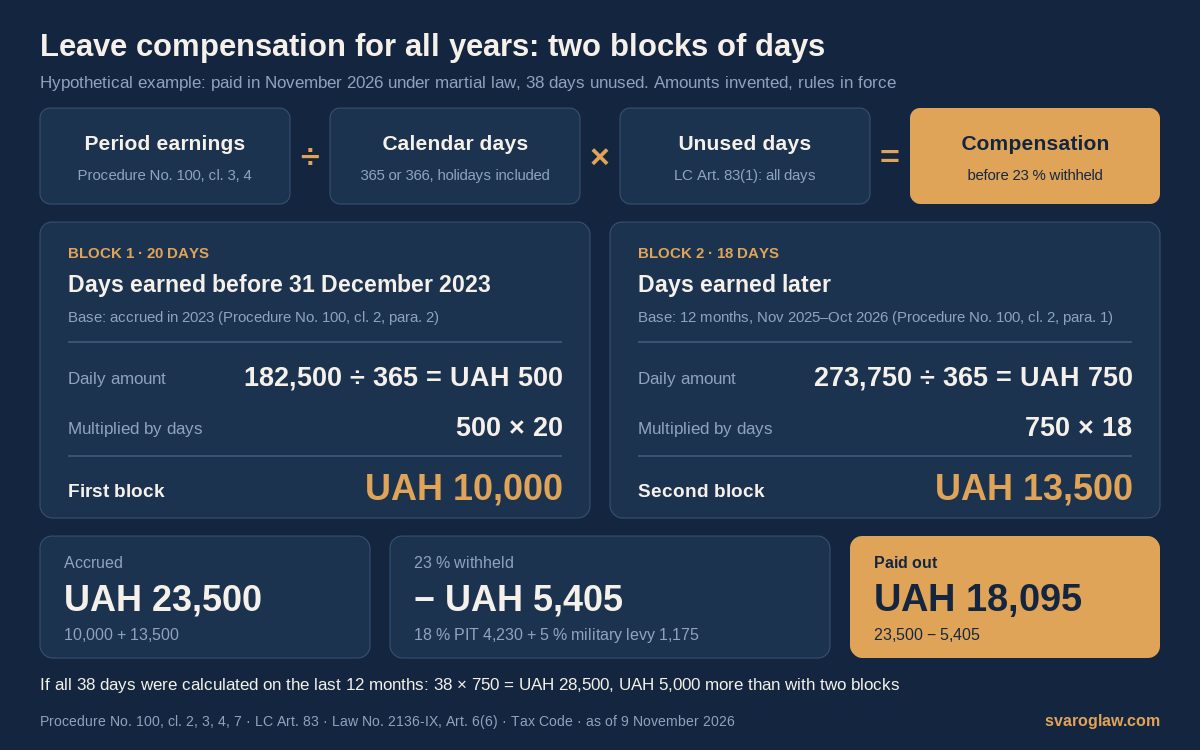
A single calculation based on the last 12 months would give 38 × 750 = UAH 28,500, which is UAH 5,000 more than the two blocks. And if the employee had spent 31 days on unpaid leave in 2023 and the accounts department had not taken this into account, they would be underpaid by about UAH 928, or roughly UAH 715 after 23 % is withheld. The correct denominator here is 365 − 31 = 334, the daily amount is UAH 546.41, and the 20 days are worth about UAH 10,928.
Before you even hand in your resignation letter, ask the accounts department for the number of unused days for each working year, with the days to which the right arose before 31 December 2023 shown separately from later ones, and for your total earnings in 2023. If their figures match yours and the money arrives on time, you do not need a lawyer. If they do not match, an employment lawyer will recalculate both blocks from your payslips.
Leave compensation with and without dismissal: all days or only those above 24 (Law on Leave, Art. 24)
All unused days of annual leave, as well as additional leave for employees who have children or an adult child with a disability from childhood of subgroup A of Group I (LC Art. 83(1); Law on Leave, Art. 24(1)).
As a general rule, only part of annual leave and only at your request: the annual and additional leave actually granted must total at least 24 calendar days (LC Art. 83; Law on Leave, Art. 24; exceptions in Art. 24(2)).
| Situation | How many days are compensated | Rule |
|---|---|---|
| Dismissal under martial law, leave was limited to 24 days per working year | All of them: the limit applies to granting leave, while compensation is paid under Art. 24 of Law No. 504/96-ВР | Law No. 2136-IX, Art. 12(1) |
| Dismissal, paid forced absence counted towards length of service | Days for that period are compensated too; in a dispute the court must determine the amount itself rather than merely order the employer to calculate it | Law No. 504/96-ВР, Art. 9(1)(2), Art. 24(1); Administrative Cassation Court of the Supreme Court (ACC SC), No. 260/5786/23 (court’s duty to determine the amount) |
| Employee under 18, without dismissal | None: replacing leave with money is prohibited | LC Art. 83; Law No. 504/96-ВР, Art. 24 |
Constitutional Court Decision No. 3-р/2026 of 19 May 2026 did not change these rules: it concerned other provisions of Art. 12 and the Final Provisions of Law No. 2136-IX, and does not affect the last paragraph of Art. 12(1) on compensation on dismissal.
Final settlement delayed: what LC Articles 116 and 117 give you
All amounts due are paid on the day of dismissal, including when you resign at your own request without working out two weeks’ notice. If you were not working that day, the employer must pay no later than the day after you demand settlement (LC Art. 116), and a lawsuit also counts as such a demand (ACC SC, No. 260/5786/23, 6 March 2025). The employer must notify you in writing of the amounts accrued, and must pay the part it does not dispute in any event. Send a written demand with your own calculation of the two blocks and keep proof of delivery: this is where pre-trial settlement of an employment dispute begins. In that case the date of the demand determines the day from which the delay is counted.
The court cannot reduce the leave compensation itself. In case No. 753/8125/17 the court of appeal applied the principle of proportionality to it, and on 8 January 2025 the Civil Cassation Court of the Supreme Court (CCC SC) called this an error, because the compensation is part of wages. Only compensation for the delay can be reduced.
Six months is only the upper limit; the court may award less. For a delay caused by the employer, LC Art. 117 gives average earnings for the whole period of delay, but for no more than six months. If the dispute is resolved partly in your favour, the amount within these limits is set by the body hearing the dispute. The Grand Chamber of the Supreme Court confirmed that the amount may be reduced after 19 July 2022 as well (No. 489/6074/23, 8 October 2025). In that case the debt consisted solely of leave compensation (UAH 61,261.02, 4.56 % of the amounts due), and the compensation for the delay was reduced from the calculated UAH 1,020,560.64 to UAH 46,537.64. The court takes into account the size of the debt, the period and reasons for the delay, and the employee’s likely losses (Grand Chamber of the Supreme Court, No. 761/9584/15-ц, 26 June 2019). Under martial law the employer may also rely on Art. 10(3) of Law No. 2136-IX if it proves that the deadlines were missed because of hostilities or force majeure.
No court fee is paid on a claim for the compensation (Law on Court Fee, Art. 5(1)(1); CCC SC, No. 127/2697/23, 13 March 2024). This exemption does not extend to a claim under Art. 117 (Grand Chamber of the Supreme Court, No. 910/4518/16 and No. 755/12623/19): the fee is 1 % of the value of the claim, within 0.4 to 5 subsistence minimums for able-bodied persons (Art. 4(2)(1)(1)). If both claims are brought in one lawsuit, one will be fee-free and the other subject to the fee, so it is worth calculating both amounts separately before seeking court representation in a case over payments due on dismissal. If your employer also owes you wages, read how to recover unpaid wages.
Three months under LC Art. 233, dismissal before 19 July 2022, and proof of days
How long do you have to sue for compensation?
Three months from the day you received written notice of the amounts accrued and paid (LC Art. 233(2)). Constitutional Court Decision No. 1-р/2025 of 11 December 2025 removed the three-month time limit in Art. 233(1) for claims for wages and other payments, but Art. 233(2) remains in force. In case No. 373/1381/25 (16 September 2026) the CCC SC held that for amounts due on dismissal the limit applies if notice was given and the time limit expired before that decision. The ruling does not resolve the situation where the time limit was still running on 11 December 2025, so we advise filing within three months.
In the same ruling the CCC SC called the Art. 233 time limit a special limitation period and held that the Civil Code rules on suspending limitation periods under martial law extend to employment disputes (paras. 92–94); the corresponding para. 19 of the Final and Transitional Provisions of the Civil Code was repealed from 4 September 2025 (para. 65). However, in ruling No. 306/2708/23 (12 November 2025) the Grand Chamber of the Supreme Court stated that the court checks the Art. 233 time limits on its own initiative, unlike limitation periods (para. 60), cited the conclusion that they “are neither interrupted nor suspended” (para. 66), and found that a lawsuit filed on 2 November 2023 had been filed out of time, without any suspension due to martial law (paras. 61–62). The CCC SC ruling does not mention this position, so relying on suspension of the time limit is risky: if three months have already passed, ask the court to restore the time limit for valid reasons (Art. 234), and cite paras. 92–94 of the CCC SC ruling as an additional argument. Without notice, judging by the words “from the day of receipt”, the time limit would not have started to run, but the Supreme Court did not expressly reach that conclusion and sent the case back for a new appeal hearing. The court may restore a missed time limit for valid reasons if no more than a year has passed since you received written notice of the amounts (Art. 234). Challenging the dismissal itself involves other time limits and requirements, which we covered in our article on unlawful dismissal and reinstatement.
How is the delay calculated if you were dismissed before 19 July 2022 and still have not been paid?
Under the Grand Chamber’s approach (No. 306/2708/23, 12 November 2025), average earnings are accrued as follows: up to 18 July 2022 without the six-month cap, and after that for a maximum of six months from 19 July 2022, i.e. until 19 January 2023 or until the day of final settlement if that came earlier. These are the limits of accrual, not an amount that will necessarily be recovered: the court may reduce it (No. 761/9584/15-ц). Where settlement has taken place, the Grand Chamber has applied to this claim the three-month time limit of Art. 233(1), running from the day the employee learned or should have learned of the settlement (No. 755/12623/19; likewise No. 306/2708/23, paras. 56–61). Constitutional Court Decision No. 1-р/2025 found the three-month time limit of Art. 233(1) for wages and “other payments due to the employee” unconstitutional; whether this covers a claim under Art. 117 has not been expressly decided in the Supreme Court rulings we found. Case No. 306/2708/23 was sent back for a new appeal hearing to establish why this time limit was missed and decide whether it can be restored.
For the compensation itself in older dismissals, a different wording of Art. 233(2) applied, which set no time limit on wage claims: on that basis the ACC SC set aside the ruling that had left a claim for compensation for the period of work 2002–2015 without consideration and returned the case to the court of first instance (No. 640/8348/21, 4 April 2023). The ACC SC assessed the Art. 117 claim separately: it was not based on a settlement already made but was derived from the main claim, so the court did not apply the one-month time limit for public service, which runs from actual settlement. The ACC SC’s conclusion does not automatically carry over to dismissals after 19 July 2022.
How do you prove how many days you have accrued?
We have not found CCC SC rulings from 2023–2026 specifically on how a private-sector employee can use timesheets to prove days accrued over many years. So in your lawsuit, set out your own calculation for each working year, attach your payslips and any copies of leave orders you have, and ask the court to order production of the documents that only the employer holds (personnel card, timesheets, orders) (Civil Procedure Code, Art. 84). The written notice under LC Art. 116 shows amounts by type of payment, so it may not state the number of days. The court in such a case must determine the amount of compensation (ACC SC, No. 260/5786/23).
Procedure No. 100, the Labour Code, Ministry of Economy guidance and Supreme Court rulings
- Labour Code (as amended on 4 November 2026), Articles 83, 116, 117, 233, 234; Law on Leave No. 504/96-ВР, Articles 9, 24; Civil Procedure Code, Article 84; Law No. 2136-IX, Articles 6, 10, 12; Tax Code (as amended on 1 November 2026); Law on Court Fee, Articles 4, 5
- Procedure No. 100 for calculating average wages (as amended on 18 December 2025), clauses 2, 3, 4, 7; Cabinet of Ministers Resolution No. 957; Ministry of Economy guidance of 1 February 2024
- Constitutional Court decisions No. 1-р/2025 and No. 3-р/2026
- Rulings of the Grand Chamber of the Supreme Court: No. 489/6074/23, No. 306/2708/23, No. 761/9584/15-ц, No. 910/4518/16 (30 January 2019), No. 755/12623/19 (8 February 2022)
- CCC SC rulings: No. 373/1381/25, No. 753/8125/17, No. 127/2697/23; ACC SC rulings: No. 260/5786/23, No. 640/8348/21